Thursday, August 26, 2010

Learning the life of a farmer

It was a CRAZY August here. Lots of harvesting, planting and visitors. We started our winter brassicas (members of the broccoli family) in the greenhouse in mid-August. We planted four different types of heirloom cabbage, broccoli, collard greens, and cauliflower. We have been direct-seeding in the ground our chicories (Italian salad green, like lettuce) since the beginning of August in successions. We are also still doing our weekly plantings of lettuce, beets, carrots, etc. We are now doing twice weekly plantings of lettuce since as the days get shorter, it will take much longer to mature to a harvestable size. We hope to have lettuce until November. Our melons are ripe and so are our tomatoes (although limited) and we have been enjoying summer squash and cucumbers for a while now. I have been making weekly batches of refrigerator pickles with the ones that we can't send to the restaurants.


The pumpkin patch


The freshly weeded chard patch with the cosmos flowers blooming in the left hand side of the photo and the trellised cucumbers on the right hand side.

There is one summer fruit we planted and will not be enjoying much of. Our tomatoes have been hit with late blight. Late blight is a plant disease that attacks mainly tomatoes and potatoes (it was the major factor in the potato famine in Ireland). Late blight is caused by an oomycete pathogen that survives from one season to the next in infected plants or in the ground. This organism is well known for its ability to produce millions of spores from infected plants under the wet weather conditions that favor the disease (it has been an incredibly foggy and wet August here). Early in the season, the disease can be introduced into a field or garden on infected plants, from volunteer plants growing from diseased plants that were not harvested last season, compost piles, or infected tomato transplants brought into the area. Spores produced on infected potatoes and tomatoes can travel through the air, land on infected plants, and if the weather is sufficiently wet, cause new infections. It causes the stem to turn brown in sections and leaves to die and turn brown.


The "blighted" tomato plant.

However the blight got to our farm, it has infected almost all of our plants. We will still have some tomatoes, but at a limited yield. It is truly heartbreaking and hard to move past. I am just glad that we are a very diversified farm and do not just grow tomatoes, or otherwise life would be much worse for us. That is one of the joys of being a small, organic, polyculture farm. One crop may die, but at least there are lots of other plants of different varieties growing too. We put A LOT of hard work into our tomato plants though, between starting them in mid-March, transplanting at the end of May, making and installing a trellis system, weeding, trellising and watering. This whole experience has helped us to realize just how hard farming is. You can do everything right and then the weather and a little bad luck blow in, and you could lose it all. It will effect our profitability, but hopefully not to much. Next year for our tomatoes we will choose a different spot for them, plant different varieties and successions ... and pray for drier spring/summer weather!

Another thing farmers have to deal with, is the weather. This August, is the coldest on record in the area. There has been a lot of fog and cool nights, as low as 45 degrees. Our plants, especially cucumbers, have been producing very slowly. Then, 23rd and 24th of August, it was over 95 degrees on the farm. Most of our plants were not used to this kind of heat. Some of our melons, which we had been waiting on to ripen for three weeks, got fried. The tomatoes that were red on the vine also fried. We did not lose anything else though and we harvested twice as much summer squash as usual on the following Thursday! I guess you win some and you lose some.

The egg that our dear hen Buffy was sitting on hatched the day after our last post (a bit over a month now) and has grown so much. It (not sure if it is a boy or girl yet) now has all of its real chicken feathers, not just the downy feathers if was born with. It has been a real blast watching it grow. All four of our chickens are laying now, which is nice. Brian got to brew his first ten gallon batch of beer in mid-August thanks to some new brewing supplies from dad; another IPA.


The chick with momma on July 16th, the day it was born.


All of our chickens grubbing on spent grain from beer brewing; you can see how big the chick has gotten (it is in the bottom left of the photo).

We always are paying close attention to how things are growing, and as long as a farmer has a field full of plants, there's always something to be thankful for.

Tuesday, July 13, 2010

Summer is FINALLY here!

Things are growing like crazy here on the farm now that it has been getting warmer. The summer squash now have flowers and tiny fruit, the tomato plants are thigh high and starting to set fruit, some of the first cucumbers are almost ready to eat, and the 1st batch of melon plants are sprawling all over! Our first real heat wave is coming on, so what better time for a summer BBQ?!


The tomatoes. Compare with the photo from the blog post on 6/22!


The cucumbers on the trellis and broccoli and chard in the foreground.

We are now in our second week of selling to restaurants. Right now we are bringing them: baby mustard mix, spinach, chard, kale, anchocress, peppercress, arugula, rucola, turnips, radishes, basil, and various herbs. We will start selling Italian broccoli, lettuce, and cucumbers next week and summer squash the following week. We will not have tomatoes and melons until mid-August most likely.


Our beautiful radishes, washed and ready to be boxed.

Now that we are harvesting and eating the first of our summer crops, we are starting to plan our winter crops, which we will have to start planting around the beginning of August. We plan to grow collards, broccoli, cabbage, chicories (Italian winter green like lettuce), root crops, chard, kale, garlic, brussel sprouts, mache, and winter squash/pumpkins (10 varieties). The winter squash/pumpkins we actually started this last weekend in our greenhouse; we have over 1600 starts! These will go out around the 1st of August into the portion of the field that has been under cover crop since mid-May.


Our 1650 pumkin and winter squash starts in our greenhouse.

The clayey soil here is continuing to surprise and frustrate us. The lime treatment we did to some parts of the field will hopefully work over the long-term, but we haven't seen much improvement yet in the tilth of the soil. On the bright side, the soil in the areas we have started to turn over from our first round of crops does seem to be working up pretty nicely. We figure it can only get better from here.

We have some good news and some bad news about our chickens... yesterday two of our hens disappeared, probably result of a coyote. Barbara our Barred Rock and our little Wellsummer went out in the morning and didn't return at night. On the bright side, Buffy our Buff Orpington hen is 3 weeks in to her broodiness with 2 eggs under her - she should be a mom soon. One of the eggs is hers and one is Barbara's, so Babs may yet live on at the farm in some form. Buffy is definitely the sweetest of the hens so she should be a great mom.

Monday, June 21, 2010

Happy Summer Solstice!

Well, all our transplants are now in the ground. We planted out all of our tomatoes, our second round of cucumbers and melons, and our greenhouse is pretty much empty!! We have finally had some hot days on the farm; we had one weekend where it was in the mid-80's. The heat is great for sun loving crops, like tomatoes. A lot of our tomatoes were quite pot bound and nutrient deprived once we FINALLY got them in the field. They were turning purple, which is a sign of potassium deficiency. Potassium is released from the soil once it heats up, which has now happened. Our early girls, mortgage lifters, and all our other varieties are looking very healthy and happy. We do not expect to have a tomato on the farm until mid to late August, but at least they are looking much happier now.

Our tomatoes have now been staked, we are just tying them all up to the stakes. The system seems to be working good so far, but the real test well be when the plants are weighed down with fruit!


The staked tomatoes.


Our cucumbers from the first round have been staked too.

We have been direct-seeding into the field now for a month. A lot of people find it interesting that we plant every week, all through the growing season. This is very different from home gardening. On a farm, you must always have a fresh product for market. Every week we plant: lettuce (several varieties), filet beans (until mid-July), turnips, cress, spinach, mustard greens (3 varieties), and beets (3 varieties). Every other week we plant bush beans (3 varieties), dill, chervil, cilantro, carrots (rainbow), arugula, rucola, and radishes. We will continue this planting schedule until about mid-august, when we start seeding our winter crops. You have to get the winter crops in early so they have time to grow to a decent size before the days are too short and the weather is to cool.

Some of our crops that we planted on June 5th (our first planting) are almost ready to sell. We hope that by the end of next week we can take the restaurants some cress, mustard greens, arugula, kale, herbs, and possibly chard. I think at this point Brian and I will fell like we have really accomplished something!


Our first seeding into the field is growing!!

Other news around the farm: We got three new little hens on the 9th. They are only 2 months old and are very cute. We picked out a Welsummer (lays dark brown eggs), a Rhode Island Red, and a Ameracauna (lays green/blue eggs). They seem to be getting along with the older hens/rooster, but not really hanging out with them. They will not being laying until September.


Brian has been doing some fishing at the pond and has landed some very large bass (2 pounders), some of which we ate. Hanging out at the pond after working in the sun all day is the perfect way to end the day!

Wednesday, June 2, 2010

Transplanting like crazy!

Well, its been a while since the last post since things have been very busy around here. We got the field disced the second time on around the 15th. After the second disk, we realized that we were going to need a rototiller since the soil here is fairly clayey and did not break up as much as we would of liked. We rented one on the 16th, since it was supposed to rain on the 17th. We worked until 11pm, but we got it all rototilled before the rains came! The soil looked much better in most spots, but there were still some areas that had fairly large clumps of clay.


Brian, driving our tractor with the rototiller attachment we rented


On the left, the soil has been rototilled; you can see the difference from the soil on the right, which has not.

We planted a quarter of our field in black eyed peas, which we are using as a cover crop. A cover crop is simply a crop that covers your field, helps block out weeds, increases soil fertility (especially nitrogen), helps prevent soil erosion, and breaks up soil. We are planning to leave the cover crop in the field until August, when it is time to put pumpkin/winter squash transplants into the field.

We started transplanting into the field by the 24th, but it was slow going in spots because of those clay clumps. Well, nature was on our side this time and sent us just over a half inch of rain on the 25th. We realized after this rain, that our spader (the closest thing we have to a tractor) broke up the soil very nice after it had been "re-soaked". We have a BCS rototiller with a Tortella spader, which works up the soil very well; it is quite the beast though! We have now spaded 1/2 the field, and most of it looks great. For the spots that still have clay clumps, we bought some agricultural lime, which is 100% natural and organic. The lime helps to break up those clay clumps.


Brian using the spader to work in the lime in a rather clayey spot!

We have transplanted a lot into the field now. We just planted out our first round of cucumbers (4 varieties) and Melons (2 varieties), along with a ton of cauliflower, kale, chard, and two of our four varieties of tomatoes. We also did our first succession of direct seeding in the field. We will we planting certain things, like lettuce and spinach, once a week, all through the summer to ensure we always have a fresh supply for the restaurants. We should hopefully be selling vegetables to the restaurants in a month.


Our 500 early girl tomato tranplants


Mary, working on transplanting.

We have had some help getting all this stuff done. A cook from one of the restaurants has been coming three days a week and Brian's cousin will start coming several times a week also!! We could not do it without some help.

Other news around the farm........
The chickens are doing great! Our rooster is healthy and crowing all day long and our hen has been broken from her broodiness. We are now getting about three eggs a day. Brian and I are both starting to feel like real farmers. We have definitely learned that you have to watch the weather and learn to just "roll with it". It is humbling to be at the mercy of nature, but also very refreshing. This May, we have received 1.6" of rain, which is about an inch over average May rainfall! This is good for a state that has been in a drought the last three years.

Tuesday, May 11, 2010

The field has been disced

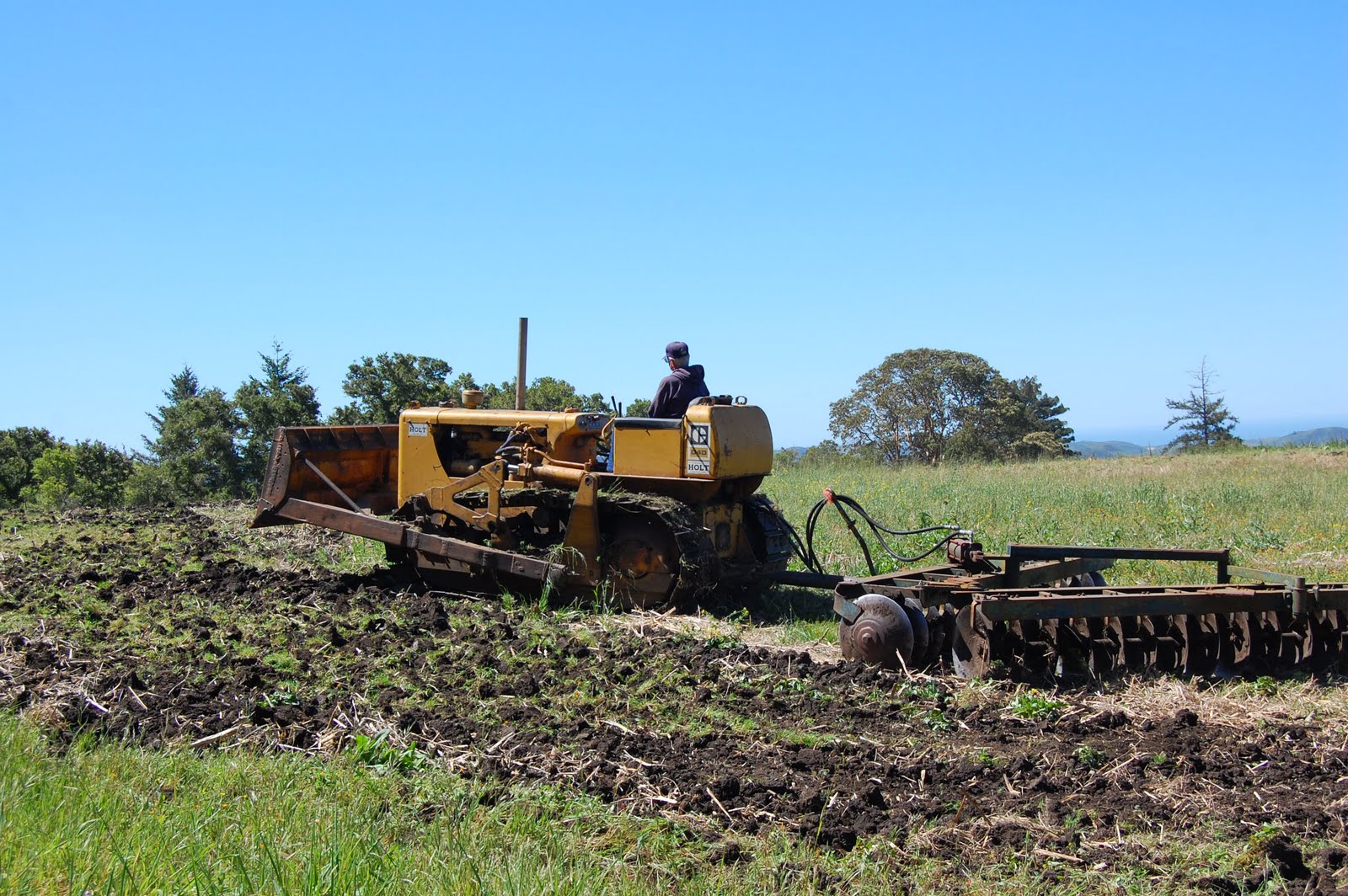
Well, it has been a busy week here on the farm. Most importantly, the field was disced last Thursday by our neighbors ranch manager. We, the farm, do not own a tractor, we just have a walk behind spader (small, looks like a rototiller). We were so excited when we saw the neighbors tractor out in our field and his ranch manager hooking up the disc to it. He drove the disc around the field about three times on Thursday, which broke up the soil very nicely. He will do the same one more time this week, once some of the biomass has broken down.


The field getting disced the first time around

Another excitment: We got our chickens! We ended up getting three hens and a rooster from a guy that was moving up in Sonoma. We got a pair of buff orpingtons, a barred rock and a sexling. We have already got about 10 eggs from them! The orpingtons are having a little trouble adjusting to their new home though. The female has gone broody (Disposed to sitting on eggs to hatch them), which would be fine, except she has no eggs to hatch! We put some fake, marble eggs in the coop so that the chickens would know where to lay their eggs and she adopted some of these. The reason it is not a desirable state to have your chicken in is because she does nothing but sit in her hen box! She does not eat, drink, lay more eggs, or go outside. So, we are trying to break it by keeping her out of the chicken coop and in a cage in the barn. Our rooster is having some bowel issues. We took him to the vet last week after noticing blood in his stool. We kept him inside for a day and he seemed great; everything was normal. Well, after a day back out, he was constipated again! We did not want to pay to take him to the vet again, so he has moved inside again where we have been feeding him things to try and "lube" him up ( apples, strawberries, peanut butter, and even vaseline). Sounds like a pretty good gig to me! (except the eating of vaseline) He has been waking us up with his crowing now the last two mornings at 5:30am! He then continues crowing until around 10am. We are really hoping he gets back to "regular" soon so that he can move back out!! We built the chickens a little run to play in until they get used to their coop, after which time we will allow them free range into the yard. They always get locked into the coop at night though to protect them from the abundance of wild life out here!


The pair of buff orpintons and the sexling.


The barred rock out in the run we built.

We moved a lot of the vegetables that are ready to be transplanted out of the greenhouse when we saw the field being disced last week. We are hardening them off -- getting them ready for cooler temperatures and more wind. We moved out our cauliflower, kale, some of our tomatoes, and chard. At night these vegetables are covered with remay crop cover, a woven fabric, to help keep them a little warmer. We are hoping these will be planted out by the end of this week or the beginning of next. We did get another 4/10th of an inch of rain on Sunday/Monday, which will delay discing by a day or two, but mostly we were very happy about the rain. It really broke up the soil and saturated it very nicely. We also started half our melons and cucumbers this week along with some watermelon. We are not going to grow a whole lot of watermelon this year, it is more of an experiment. We are trying two seedless varieties so see how they do and growing one big,red one. Oh, we can't wait for those to be ready (probably not until August)!


The plants being hardened off are under the white "box". Our greenhouse behind it and the beautiful disced field in the background.

Anticipation is really starting to build now, and we can almost see the light at the end of the tunnel - the tunnel being an unusually wet and cold spring! With only 6 weeks left until summer, we know that the cool damp weather has to be coming to an end. Mornings are still quite crisp, with temps dipping in to the mid 40's. They say the warm season extends quite late around here, so we'll be hoping for that indian summer to bring hot weather in through September/October. Well we need to get out to work now, but hopefully our next entry will be all about everything we've been planting and transplanting in the field!

Sunday, May 2, 2010

Its May!

Well, it's May and I think the rains have stopped! We definitely have a lot of water in the pond to last through the season and the ground is pretty well saturated! We are really hoping to have the discer (plow) in the field this week. It seemed that throughout April, every time the field finally dried, it would rain again, and not just a little, but 2" of rain in a day!! As they say "April showers bring May flowers"...

This week we worked on our tomato trellises. We are gathering redwood boughs (off the ground) to use instead of buying some cheap (but not really that cheap) lumber from the store. We cut the boughs to 8' long, criss-cross two pieces and screw them together to make an "X". Then we put a bar across the bottom to help reinforce them. Once we get them into the field, we will space them every 15' straddling 2 rows of tomatoes and run wire the length of the row connected to the top of our "X"'s. The tomatoes are supported with twine connecting from the plant to the wire above. The plant will then grow up the twine, hopefully to the top of the trellis. We have never tried this before, but we think it will work. We did install one in our "experimental" garden, where our heirlooms are planted.


Our tomato trellis

Yesterday, we got our chicken coop delivered to the farm! It is a 4x4x4 cube, which can hold up to 12 chickens, but we will probably only have 5 chickens. We have started looking for layers on craigslist; we are really looking forward to the fresh eggs (and manure)! It is very sad how chickens on large scale farms get treated; beaks and wings clipped, no room to turn around, etc. If you can grow your own or find someone who sells them off their farm, I would highly recommend buying them this way. Even some of the "free range" chicken eggs you can get in the store have their beaks clipped. Chicken beaks are like our fingers! They use them to explore the world and pick stuff up. Also, farm eggs or free range chicken eggs are MUCH healthier for you. The chickens eat food that is more natural to them, grass, bugs, worms, etc and their eggs are much higher in Omega fatty acids (the ones that are super good for you). If you can't buy eggs from a farm, then at least try to buy the ones at the store that are free-range, because these chickens do have the opportunity to go outdoors.


One side of the new coop


The other side, which you see inside the roost and laying boxes

Things are going good in the greenhouse and many things are really ready to go out in the field! I feel like somedays, our tomatoes double in size in the green house. We are hoping to start our cucumbers and melon seeds soon. We will grow Armenian cucumbers, french cantaloupes, "regular" cantaloupes, pickling cucumbers and English cucumbers (more your standard cucumber). We are really looking forward to eating these crops!!


The early girl tomatoes, which are looking great!

Other than that, not much has been going on. Brian and I have been getting out on more road bike rides, doing anywhere between 14 and 25 miles. Brian brewed his 2nd batch of "all grain beer" and we have been enjoying drinking his first batch. Kazy is doing lots of hunting of voles and mice -- up to 3 in a day!

Monday, April 19, 2010

On our own now!


This is a picture of the farm we run from a-far with the pond!

Well, its been way too long and I sort of lost track of time with my blog! Sorry!

Brian and I left our internship at our last farm a little early, on Christmas. We left because we got an offer to manage a three acre farm in Woodside, which has been in existence for 9 years, for a bay area restaurant group. After seeing the property and the unique opportunity, we could not say no. We felt we had learned enough at our farming internship to try it ourselves! The farm is in the Santa Cruz mountains, within the rural area of Woodside. There are three acres of farmland set on a 600 acre cattle ranch. We can see the ocean from the house and farm and are surrounded by redwoods! Brian and I will run the farm and sell vegetables to three bay area restaurants. We have about 40 to 50 varieties of vegetables planned for the season. We live on the property in a barn that has been converted to a very nice house. We have our own kitchen and an indoor toilet (at the internship we just had a port-o-potty). There is also a beautiful pond that we are really looking forward to swimming in on hot days!


The barn, which we live in the left-hand third of. The center is actual barn, and the right hand side is a garage.


The pond, which ducks live in and we intend to swim in!!

After leaving our internship we went back to Mexico, this time to the Yucatan. We drove, had an amazing time visiting all the ruins and cenotes, and racked up 10K on our trusty Subaru! It was a great trip.
We moved out to our new farm on March 1st and have not been able to get into the field yet since we have had SO MUCH rain, which is a good thing. We have been planting a ton in our greenhouse (which is a hoop house made of PVC and greenhouse plastic, which is 40' long and stuffed to the gills). We have over a thousand transplanted tomatoes, a lot of kale, chard and cauliflower. We also have some eggplant, basil, and herbs started. We are now just waiting out all these rain storms to actually plant in the field!!


A shot inside the greenhouse.

We have also built some "New Zealand Compost Boxes" and are making plans for a chicken coop. It is time, finally. We want to get between 5 to 10 mixed purpose chickens to have around. We also have a small garden area that is not far from the house (separate from the 3-acres) in which we planted heirloom tomato starts and potatoes. It is our test garden. We want to try some things before planting a ton of it and then not liking it! Oh, and not to forget, our cat Kazy, has been helping us to reduce the population of voles and mice around here!

I will really try to keep this thing updated this time, but we shall see. Hope it's a great growing season this year!

This is a shot of the field a bit more "up-close"; from our deck.

Sunday, July 26, 2009

Almost at 4 months now!!

It has been crazy out here. #1, I am sorry for not keeping in touch lately, but it's hard out here! We start work at 6:30 and work til around 5 or 6 at night. Then we eat dinner with the other interns and before you know it, it's 9 and time for bed! One of my 2 days off, I work at another internship in Point Reyes (for Marin Organic). So in short, my life is a little insane right now, but I LOVE IT!!

Whats new at the farm? Well, summer crops are starting to come in! We have been bombarded my summer squash for a couple of weeks now and the cucumbers are starting to go crazy too!!!Our lettuces, broccoli and basil are all doing great. Our 10,000 tomato plants have been stacked and now have blossoms. They should be ripe in September. We got our first eggplants and peppers coming on in one of the farm hoop houses!! The strawberries have slowed down a little due to the heat, but they still taste way better than anything you could get at a store. The corn I planted 2 months ago is about 10 feet tall but has no flowers yet. We have started sowing some winter crops already: winter squash and pumpkins.

Brian and I are starting work on a greenhouse that will be 17x60 feet. We hope to finish it soon so we can start some of our winter crops in there before it's to late. We started drilling the holes for it yesterday which reminded me a lot of my old line of work :). I am sorry to say, but I don't really miss the work (just the people). I think this is generally how Brian and I both feel! We are both looking forward to having our own farm some day in the future (and are a little scared too). We really enjoy our jobs and feel like we completed something at the end of the day. It makes for a lot of hard work, but it's so rewarding.

We are still learning a lot out here about tractor driving, sales, plant varieties and learning to deal with what nature gives you! We have been trying to get into town a little more lately. We have been dancing with the crew, went to a baseball game with almost everyone from the farm, had a fiesta at the farm, and are enjoying local microbreweries! We have started brewing out second batch of beer,a porter and are looking forward to drinking it. Hopefully it will be ready to go before we go up to Oregon in 2 weeks!! We are really looking forward to this trip home and we also hope to go visit some farms along with some friends!!

Anyway, hope you are all doing well. We will get some pictures up some century :)

Tuesday, June 2, 2009

Wow, here we are at 2 months.

As you can probably tell, we have been getting in to the busy season here. A month has gone by and we have seen massive change on El Rancho. Lettuce heads from seeds planted 4 weeks ago are approaching harvest time. Strawberry plants have gone from having 1 barely ripe fruit on each one, to flourishing with 6-8 ripe fruits at a time. Today the last transplants of our 10,000 plant tomato field went in the ground. The days are getting long both in terms of sunlight and work, but it is an exciting time in our world of produce.

We are still 100% thrilled we are following our dream to eventually start our own farm, and this is a perfect first step. More interns are joining the staff which will provide us with more time to learn at greater depth. Most days, the washing and packaging of all the produce being picked has taken up most of our time. We have, however, found plenty of time for side projects like building and filling 2 large planter beds with local native flora, planting and maintaining long beds of herbs and an experimental garden. We are learning tons about farming every day, as well as improving our Spanish speaking since we are in close communication with the crew.
All the hard work hasn't prevented us from having lots of fun doing our own things. In the past couple weeks we have made our own soap (Mary's 2nd time), made homemade mozzarella cheese (1st time!), and brewed our first batch of beer which will be ready to drink very soon! When we had some extra strawberries lying around, Mary made 2 batches of strawberry jam which were really simple to cook up, but sooo delicious. Today while Mary was at work, I caught 2 good-sized bass out of our pond which we'll have for dinner tomorrow night. Now that the weather is getting significantly better, we will probably be out on our bikes more frequently, too.

Working with the earth every day is incredibly enriching and rewarding, in ways we have not appreciated before. Learning the ways of many different species of plants, adjusting to the constant changing of the weather here, interacting with innumerable animals from gopher snakes to red-winged blackbirds to angus cows, and immersing ourselves in farming and the natural world has been a transforming experience. We are both looking forward to the summer months, anticipating an extremely busy and prosperous season for the farm. I think we are equally anxiously anticipating the summer crops just for our own consumption.

Our prime crops for the next few months will be our various lettuces which comprise about 1/3rd of our cultivation and sales, Arugula/Rucola, Strawberries, Tomatoes, Peppers, Squash, Basil, Sweet Pea flowers, Broccoli and Spinach. Other secondary crops will be various bitter greens for salads and cooking, herbs, fava beans, several cresses, and root vegetables such as onions, beets, radishes and turnips. Additionally on the property we have tons of blackberries -- YUM!!! I think I am gaining weight just thinking of all the delicious dishes and treats we will be concocting from our multitude of fruits and veggies.

We hope to not to take so long for our next post, but like the weather here, you just never know!!

Friday, May 1, 2009

One Month

Well, today we have been on the farm for a month! We still love it. It has been crazy lately here on "el rancho" (starting to get into planting summer crops). Last week, we had a little heat wave; it was 93 degrees for a couple days! Things grew like crazy. Lately, we have been working on the herb garden, planting sage, thyme, rosemary and other experimental varieties. We have to dig up the herb garden by hand, so its a lot of hard work. There has also been a ton of planting of going on in the field lately. It seems that half of the 28 acres has been planted since we arrived. We just seeded basil in the field last night, along with some more lettuce. Lots of vegetables are grown on the farm, but lettuce is the main crop. There are at least 10 different varieties!

We went with the farmer to get some seeders for the tractors in Salinas this week from a large scale organic farmer friend of his (he had just planted 60 acres of summer squash). It was very interesting to drive through Salinas, since this is the heart of large scale farming in California. The seeders will go on the back of a tractor to seed "beds". The beds on our farm are 60", but it seems like on the larger scale farms the beds are 80". We plant generally 5 rows to a bed, but sometimes less. We will plant only two rows of squash in the 60" bed. In the large lettuce fields in Salinas, they plant 12 rows to an 80" bed! They pick it by essentially mowing it with a large picking machine. That is pretty much the opposite of how we do it here at our farm. Yet, it was very interesting to see how things are done on an even larger scale! Most of the farms in Salinas that we saw while driving did not appear organic (no weeds kind of gives it away).

Looking back, this last month, we have really discovered how different a farm is from a garden in your back yard. In a garden, you weed everything and it all looks so nice and organized. You manage your pests (hopefully organically) and pick almost anything that is ripe. Things are different here, on the "small" 28 acre farm we live on, considering that the average farm size is around 450 acres. Small farms, however, account for only a very small share of total farmland. Farms with fewer than 50 acres operated less than 2 percent of all farmland in 2002, while farms with more than 1,000 acres operated two-thirds of all farmland (http://www.ers.usda.gov/AmberWaves/November07/DataFeature/). When a crop gets hit by pests, we usually will just mow it down. The limited amount of weeding that we do is done by a tractor that gently plows between the rows of young plants. Since we have several different crops, if one is lost to some bug, it is not a huge deal. There are also several beds of each crop planted at different times on the farm (successions). Therefore, if one crop gets hit, in a week or two, another bed of it will be ready elsewhere on the farm. Also, not everything always gets picked. Some crops towards the end, will just get mowed and disced into the soil and will increase the organic content of the soil.

We are learning lots every day and looking forward to applying what we've learned on our own farm sometime soon.

Wednesday, April 15, 2009

Farming Lessons #1

We are loving life out here on the farm -- even though yesterday we had gale-force winds which demolished one of our "hoop houses." (A hoop house is a type of simple greenhouse which is constructed with semi-circular "hoops" made of PVC pipe covered in plastic) This past week we took part in harvesting a couple days, went to our usual farmers markets and called some restaurants to gather orders. It is a transitional period on the farm right now, with the winter crops on their way out and the spring crops just beginning to come in. We were picking garlic in the farthest field and felt obliged to check on the young strawberry plants. We managed to find a couple dozen of the first ripe strawberries which we figured should be tested for quality control. They passed the test with flying colors :)

I want everyone to learn along with Brian and I about farming. I plan to try and occasionally post some important lessons we have learned here. This week: why organic food costs so much.

On this smaller scale organic farm, EVERYTHING is harvested by hand. What is growing out here you ask? Lettuce, chicories (a bitter Italian green - think Radicchio), onions, garlic, several bitter greens, arugula, several varieties of kale, chard, herbs, several varieties of cress, radishes, beets, turnips, and more. We will have tomatoes and strawberries in the summer (so excited!). This farm sells to several restaurants, restaurant distributors, and at farmers markets. That adds up to a lot of picking. There are laborers on the farm 7 days a week! Some crops are easier than others to pick, but some are very time consuming. Take arugula for example. What we sell is very small ("baby" arugula), with the leaves being no bigger than 1 inch. The arugula does not grow in a head, like lettuce, but grows like grass, in single blades. The arugula will be "mowed" by hand with a pair of scissors; a pound takes us about an hour to pick (the professional laborers take maybe half that time). There are also lots of weeds to sort out since no sprays are used on this organic farm. Now, you take an hour of labor for one pound, add the price of seed, and the price to prepare the ground for seeding (tractor fuel and labor), the cost of irrigation (water and pipes), the cost of the piece of land (this farm is leased), boxes to package it and fuel to take it to market -- that pound of arugula gets pretty costly. This is why I get annoyed at farmers' markets when people complain about paying $8 a pound for the arugula. It costs more than that just to pick it!!! Plus, a full pound goes a long way on the table. Your average green salad may weigh 1/4 pound..
Of course, before I got out here, this was not something I really thought about, which is why I consider it a lesson. I never really thought about how much time goes into that basket of strawberries or that head of lettuce. Now, I have a better idea. Organic farming is much more labor intensive, at least when it comes to picking, than conventional farming.

We have yet to download our yurt pictures, but we will try and get them up this week!

Tuesday, April 7, 2009

First week on the farm

We moved in to the yurt last Wednesday, and so far our time on the farm has been great. While small, we are able to accommodate pretty much all of our essentials within the 12-foot diameter living space. Never thought that would be possible. Our 6 x 8 x 10 foot (off-site) storage unit is packed to the gills, however.

In our first week we became familiar with the layout of the fields, and on a 27-acre farm that means a lot of walking! Several days we took part harvesting with the crew, most of whom are from Oaxaca, Mexico, and are all very genuine, kind people. Brian rode along with the delivery truck one morning and made 17 stops to various restaurants and distributors. We sold our goods at several farmers markets and generally began to learn the daily and weekly flow of the farm. We are heading towards the very busiest time of the year, where we will be growing tons of lettuces, strawberries and tomatoes - the most popular items by far. Weekly, the farm will sell at 8 farmers markets in the bay area in addition to the regular sales to restaurants and wholesalers.

There is a huge amount for us to learn but everyone seems to be quite helpful and we are eager to experience as much as we can in the next 10 months. The lifestyle adjustment has been very pleasurable so far but we know that there is much work to be done, particularly once we get in to Summer! Some mornings we are up well before the sun, but the rewards of having zero commute time and the beautiful surroundings are immense.

Pictures coming soon!

Back from Mexico!

See the photos! http://picasaweb.google.com/marybrian2

We made it back from Mexico unscathed! We braved the food, water, insane drivers and managed to not get sick and didn't run in to any troubles on the road (either literally or figuratively speaking). What a grand time we had!

It took us over four full days to drive from Oakland to Manzanillo, where we stayed for 9 days. On the way down we stopped in several coastal towns, including Mazatlan and our favorite, Puerto Vallarta. Our main purpose in Manzanillo was to attend our friends' wedding, and Brian performed the ceremony for them - he's an ordained minister, didn't you know?! They had a beautiful wedding right beside the ocean, and everyone had a great time. Our other activities in the area included fishing, snorkeling, driving ATVs around the beach and hills, riding a zip-line about 1500 feet and just general sightseeing.

From Manzanillo, we headed northward for our return leg and stopped in Guadalajara (Mexico's 2nd largest city) for 3 nights. We stayed just outside the city in an area called Tonala, where the majority of all the great manufactured artisinal goods are produced. There are all kinds of workshops within about a 10 x 10 block area, which produce pottery, glassware, metalwork, textiles and jewelry and all sorts of art. We went in to the Guadalajara city center and spent time in a massive marketplace which spanned about 4 whole city blocks - just about anything you can imagine is for sale there, and shopping is the sole reason why many people travel to Guadalajara. It was a bit overwhelming, particularly because "gringos" aka "gueros" are vigorously targeted by all the shopkeepers since they see light-skinned people as great targets for sales. We were savvy shoppers however and came away with some great bargains, and saw many beautiful areas of the downtown area as well.

Continuing northward, we went through the town of Tequila in Jalisco where mezcal or tequila production began. We toured an amazing old factory which still produces tequila in the traditional method after almost 150 years in production. We stayed in San Blas, where we took a boat ride through mangrove forests and saw many crocodiles and majestic herons, egrits and other waterfowl. We revisited Mazatlan on the way back up and were left less than impressed by that city overall, mainly because of the scale that "Americanization" has occurred. Our final night in Mexico was spent in a "resort" hotel in San Carlos which was falling in to a state of disrepair. We were able to book an oceanfront room for $60USD and were 2 of probably a dozen guests in total who stayed that night -- the once 4-star resort had over 200 rooms but was obviously struggling to bring in business. San Carlos is a beautiful sleepy coastal town and seems to understandably be a popular retirement spot for Americans and Canadians. Unfortunately, our digital camera broke that night so we made use of our 35mm film camera the rest of the way.

After 18 days in Mexico, we crossed back over the heavily fortified border in Nogales, AZ and headed to Death Valley for a couple days of re-acclimitization of sorts. We stayed in Phoenix for a night and found a great little authentic Italian restaurant where we ordered a pizza which was about 6 square feet worth of pizza. We were expecting leftovers when we ordered the "metro" size, but we didnt expect to be eating pizza for 4 meals straight. It was really darn good though, and we felt like we were in college again waking up and eating nothing but leftover pizza for a whole day.

Death Valley is a special place to us and we were fortunate to be passing through during a better-than-average year for wildflowers. During our one whole day there, we drove from -196 feet sea level up to 6800 feet to the Charcoal Kilns which were built around 1870. From there we hiked up past 9000 feet to Wildrose Summit where we had panoramic views of the valley and even Mount Whitney. We were both feeling the effects of the altitude by the time we reached the summit so we made a brief stop and descended. After two nights in the valley we made the long 500 mile drive back to Oakland. Our Subaru was quite happy to have completed the 5200 mile trip, and we were all grateful to have made it back the same shape we left in!

While in Mexico, we ate all kinds of wonderful food, the best of which was generally $10 or less for the two of us to eat a full meal. We most enjoyed all the different types of salsas/moles and the seafood was excellent. The vast majority of people were extremely nice and went out of their way to help us find our way or to supply us with whatever we required. We saw little to no signs of the drug war that we have heard so much about in the press, but we certainly heard plenty on the news about the conflicts going on in the bad areas. We came away from this trip with a much greater appreciation of all the dynamic relationships that "Americans" have with Mexicans, and also an immense desire to learn more about their vast country.

Thursday, March 5, 2009

The beginning

Before we start our farm life, we are going to spend three weeks on vacation in Mexico. Some very good friends of ours our getting married in Manzanillo next week. We are making an adventure of it and driving down from Oakland. We plan on spending about 6 days driving down and then hang out for a week in Manzanillo. We will then head to Guadalajara then back up the coast, back into the US. I hope to have LOTS of pictures to share with everyone once we get back.